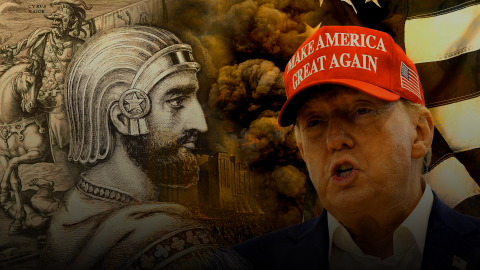
A clash of the ages

“Neither snow nor rain nor heat nor gloom of night stays these couriers from the swift completion of their appointed rounds.”
These words were carved onto the post office building in New York City around 1912 by the architect, William Mitchell Kendall. Over the course of time, it became the unofficial motto of the US Postal Service.
The phrase itself originates from the Greek historian, Herodotus, who was describing the Persian courier system.
Persia was the world’s first superpower. It existed about 600 years before Jesus Christ walked the earth and before the United States of America was even a thought.
It was founded by Cyrus the Great and, at its prime, controlled vast tracts of land in Europe, Africa and Asia.
The Persians built an extensive road system, including a 2500km stretch known as the Royal Road. It linked the western city of Sardis to the administrative capital, Susa.
On this road were 111 relay stations staffed by couriers on horseback. This allowed the Persians to deliver a message from one end of the road to the other in seven to nine days. At the time, it was an impressive feat.
At the heart of the Persian army was the Immortals. This elite unit numbered 10, 000 men. When one fell or was injured, he was immediately replaced, ensuring the unit’s strength never fell.
The Immortals were skilled archers, weakening their enemies at long range, before taking them on with spears in close combat.
The Persians fought multiple generational wars. The Roman-Persian wars spanned over 700 years, although it was not a single battle but a series of conflicts.
Cyrus the Great didn’t just lead his armies into battle. He also won the hearts of those he conquered.
Under his rule, there was equality, as well as religious freedom and freedom of choice and movement.
His thoughts are contained in a baked clay cylinder, The Cyrus Cylinder, which is regarded as the world’s first charter of human rights.
Today, a replica of this cylinder is permanently displayed at the United Nations headquarters in New York City.
Alexander the Great, a Greek king, eventually toppled the Persian empire. He burnt its capital, resulting in widespread death and destruction.
Today, Persia’s modern-day capital is once again on fire. Parts of Tehran have seen significant fires following airstrikes by the United States and Israel.
Persia became Iran in March 1935. It was the name locals gave to their land and means “land of the Aryans”- the people Adolf Hitler believed to be among the most superior.
Today’s war between the US and Iran is therefore a clash of the ages – a modern- day superpower taking on a superpower from antiquity.
The US would be wise to reflect on history because much of the strategy employed by the Iranians is rooted in Persian tactics. Fighting is in their DNA.
The spirit of the Immortals now resides within the Islamic Revolution Guard Corps (IRGC). The bows and arrows they once used are now missile launchers and missiles. There are also drones that the Iranians have used to devastating effect. Furthermore, Iran has built a network of underground bases from which to launch these missiles and drones.
The country has decentralised military command, meaning that, irrespective of how many generals the US and Israel kill, the system will continue to operate.
As a result, despite the US and Israel having almost complete air superiority, the Iranians have been able to successfully launch counterattacks.
Their missiles and drones have been effective, especially when you consider that they must travel about 1500km to reach targets in Israel. That’s the distance between Johannesburg and Cape Town.
What’s more, Iran’s missile technology is a lot more advanced than previously thought.
Recently, they apparently launched two medium-range missiles against a US / United Kingdom airbase at Diego Garcia, more than 4000km away from Iran.
Until now, it was thought Iran only possessed missiles with a range of less than 2000km.
Overall, the Iranian military has proved to be more potent than thought. They managed to hit an F35, a stealth fighter plane considered the most advanced in the world.
The US has also moved its giant aircraft carrier, the USS Gerald R Ford, to Crete for repairs.
The Iranians claim they hit the ship, causing a fire. The US claims there was a fire in the laundry room. They are also investigating the possibility that sailors are demoralised after a record-long stint at sea and want to return home.
Whatever the case, the fire burned for 30 hours before being brought under control. It dents the aura of invincibility once associated with the US military.
What’s now clear is that some sort of ground offensive is inevitable. Israeli Prime Minister Benjamin Netanyahu has already said this publicly.
There are several reports that the US is sending amphibious assault ships and between 2500 and 5000 marines to the area. It is most likely that they would be used to secure the Iranian shore off the Strait of Hormuz.
But they are likely to face stiff competition from about 200 000 IRGC troops and a further 600 000 attached to the regular army.
In the 1980s, Iraq tried to invade Iran with a far larger force than the Americans have in the region. They failed, despite support from both America and the Soviet Union.
Iran has been invaded several times over the centuries, but nobody has been able to hold the territory for any significant period.
It now seems likely that hostilities will continue for the next few months. This became clear when the White House recently requested an additional $200 billion for the war.
With the war costing America around $2 billion a day, that’s enough to sustain fighting for around three to six months.
But it has also pushed up America’s debt. A few days ago, the money the US has borrowed shot up to over $39 trillion.
To put into perspective just how much money this is, consider that South Africa plans to raise just over R2 trillion rand this financial year. We would need every cent of this tax revenue for the next 332 years to pay off the US debt.
But the biggest threat the US faces is the end of the so-called petrodollar.
Back in 1974, the US and Saudi Arabia agreed that oil would be sold in dollars. In return, the US would ensure the security of the kingdom.
The oil producers like Saudi Arabia used their many dollars to reinvest in American markets, strengthening the US financial system.
Recently, Iran floated the idea that it would allow oil tankers to pass through the strategic Strait of Hormuz but only if they paid in Chinese Yuan.
If this were to happen, the dollar would weaken. It would trigger inflation in America and make the cost of repaying the $39 trillion debt more costly. Put differently, it could mark the beginning of the end of the US as a superpower.
Today, much of what was once Persia has been forgotten. Other than the Persian Gulf there is little else named after the world’s first superpower.
Ironically, US President Donald Trump has made a big deal about renaming the Gulf of Mexico. One of his first moves after coming to power was to sign an executive order renaming it the Gulf of America.
In the centuries to come, one hopes there will be much more to remember the United States of America than the Gulf of America.
By Aakash Bramdeo
Aakash Bramdeo is the Business and Politics Editor at eNCA