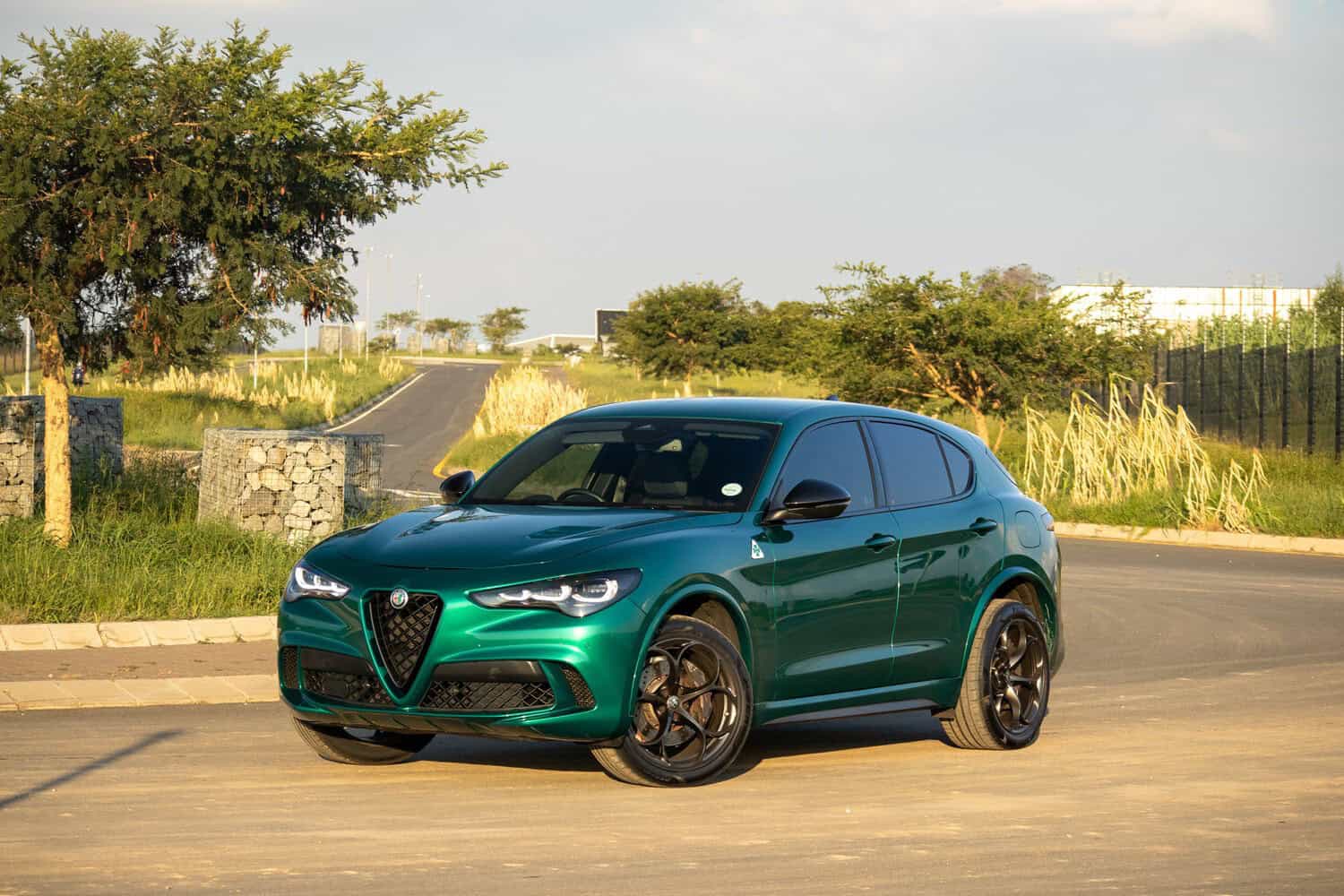
Alfa Romeo Stelvio Q a symphony of passion and poise

Reversal of the EV-only policy means the Stelvio Q will remain on sale until at least 2027.
The regression in electric vehicle sales across Europe is well-known and has resulted in a number of marques reassessing their reliance on making only EVs.
EV only no more
Along with the European Union relaxing emissions regulations that called for a total ban on the internal combustion engine by 2035, most manufacturers are now reverting back to petrol and, in some cases, diesel engines.
One of the most prominent is Stellantis, who in 2021, tabled an all-electric future starting with Fiat in 2025 and ending with Opel/Vauxhall in 2028.
Since then, it has been forced to re-adjust its plans by introducing hybrid variants of previous EV-only products to help volume and reduce costs.
No exception to this is Alfa Romeo, which had been lined-up for an EV-only future by 2027.
But due to Stellantis’ backtracking, both the next generation Giulia and Stelvio have been delayed from their respective EV-only unveilings in 2025 to 2026, to hybrids in 2028.
Open for ordering
This, together with the continuation of the 2.9-litre bi-turbo V6 in the Stelvio Quadrifoglio and Giulia Quadrifoglio Verde (QV), has now spilled over to South Africa.
Since February, orders can once again be placed until at least 2027.
Having not undergone any changes since their last updates in 2023, the resumption of orders came with the renewed opportunity to sample the Stelvio Quadrifoglio, albeit with a caveat: a stay of just over 24 hours instead of the usual seven days.
Verde Montreal, or Montreal Green, is one seven available colours. Picture: Rynhardt Steenkamp
Decked out in Verde Montreal, one of seven colours available, the “test unit” had served most of its time in Stellantis’ marketing fleet.
As such, it wasn’t box fresh, however, as this was known before taking delivery, no nasty surprises could be expected.
Devoid of any curb meets or glitches throughout its recorded 24 000km, setting sight on the Stelvio Q still comes as an eye-opener, even before uttering the tiered and overdrawn expressions associated with any Alfa Romeo product.
Styling stereotypes tricky not to utter
As part of the updates, the Q, as with the rest of the Stelvio range, received the 3+3 LED headlights from the now pre-facelift Tonale, a new front bumper and grille, and what Alfa Romeo calls “burnished” 20-inch alloy wheels.
Unique to the Q are carbon mirror caps, a black grille surround and red Alfa Romeo lettering on the brake discs.
At the rear, the bumper and diffuser have been restyled to accommodate the quad exhaust outlets, with the final tweak being darkened light clusters.
Stelvio rides on “burnished” 20-inch alloy wheels as standard. Picture: Rynhardt Steenkamp
Often the most subjective aspect of any vehicle, in this instance, there is little to describe as the Stelvio Q as having been designed for no other purpose than performance.
While the Alfa descriptive terms such as “soulful”, “passion” and “beautiful” are often the first thoughts, the Q is unapologetically aggressive and without restrained.
Helped by its colour other than the usual Rossa Alfa, the Stelvio Q is a drama packed prospect that very little of its immediate rivals can match.
Dated but still focused inside
In contrast to its finely tuned exterior, opening the Stelvio’s door provides the biggest hint of its now decade old age.
While the 12.3-inch digital instrument cluster from the Tonale with its periscope-style binnacle remains, the rest of the design hasn’t changed.
Interior feels driver-focused and upmarket, but also dated in certain areas. Picture: Rynhardt Steenkamp
Besides the carbon finishes on the centre console, dashboard, steering wheel and doors, the cabin feels its age, with the 8.8-inch infotainment display being the biggest giveaway.
The flip side is that the cabin’s ergonomics are still easy to understand and ideally laid out.
From physical buttons for the climate control, to proper buttons on the steering wheel and the BMW-style iDrive controller for the infotainment system, the cabin is still inviting and driver-focused.
Front seats are bolstered and comfortable, and the driving position is near perfect. Picture: Rynhardt Steenkamp
At the same time, built quality is premium, fit-and-finish without much making noise about, and the driving position about as close to perfection as one is likely to find.
In fact, the position of the volume knob for the sound system is perhaps the biggest irritation, as it remains set up for left-hand drive markets.
Practicality
As nitpicking as this is, though, the biggest complaint is rear passenger space.
Best described as snug, the rear quarters will be on the tight side for some, especially legroom, thanks to the sport seats up front. Headroom is a touch more agreeable, but by the smallest of margins.
Despite its performance focus, practically has not been skimped on as opening the electric tailgate reveals a 525-litre boot. With the rear seat dropped, space increases to a sizable 1 600 litres.
Real Alfa to drive
Avoiding the usual Alfa Romeo stereotypes becomes the hardest to ignore when pressing the starter button on the steering wheel and setting off.
Up front, the almost fabled Ferrari-made V6 bi-turbo bent-six staggers in a way the 2.0-litre turbo in the normal Veloce underwhelms.
Pumping out 375kW/600Nm, the V6 is slightly hobbled by an initial bout of low-down lag, which quickly disappears in what can only be described as a brutal way.
Left in its default Normal setting, the Q is unfiltered and beautifully poised despite tipping the scales at 1 830 kg.
Admittedly not as razor-sharp as the rear-wheel drive Giulia QV, the Stelvio Q is still scintillating to drive and a bit more manageable thanks to the Q4 four-wheel drive system.
That being said, switching the DNA mode dial to Dynamic turns brutality into savagery as flooring the accelerator lifts the nose up and propels the Stelvio forward with unabating momentum.
With all four wheels gripping and the V6 growling, it becomes an occasion and a sensation of wanting to drive without stopping.
The opposite of the Veloce that felt its weight and lacked the excitement, even of the 2.0-litre Giulia, the Stelvio Q’s dynamics are better sorted, which elevates the excitement factor even more.
Aiding this are the magnesium paddle shifters for the ZF-sourced eight-speed automatic gearbox.
Fixed to the steering column instead of the wheel, the shifters stay put and such, work in tandem with the driving position and supportive seats to create a proper driver’s feel behind the wheel.
In fact, not resorting to flicking the paddles can be considered an injustice, as the level of engagement, rather than simply leaving the otherwise sublime ‘box in Drive, needs to be harnessed.
You will have to make sacrifices for…
Switched back to Normal, it becomes almost docile, yet with the same fantastically weighted steering and sorted transmission.
Unsurprisingly, the ride is firm and, unlike the Veloce, not as forgiving when it comes to ironing out imperfections.
Sudden surface changes are easily felt and, as such, will require even greater than normal pressure to scratch a wheel.
In isolation, the mileage accumulated over the “test unit’s” life had an effect on the brakes. However, as mentioned, this was expected, and such care was needed.
Likely to be of little concern, fuel consumption after just over 100 km registered a best of 15.6 L/100 km.
Conclusion
Priced at R2 225 900, the Alfa Romeo Stelvio Quadrifoglio is anything but a cheap performance thrill, even when compared to its more fancied British and German rivals.
Not as visceral or ultra hardcore as the Giulia QV is, it still warrants the iconic green cloverleaf badge on its front wings for feeling more Alfa Romeo than the Veloce.
As much as certain Alfisti are still unlikely to accept an Alfa Romeo SUV, or even one with the badge in question, the Stelvio Q is still something special, if only for a select few.