Constitutional Court rules on the differences between states of disaster and emergency

Two differing judgements argued the constitutionality of states of disaster and the ability for parliament to conduct oversight.
The Constitutional Court on Friday released a judgement relating to legislation governing national states of disaster and states of emergency.
A hearing related to a six-year-old application submitted over the 2020 national state of disaster were finally held on 6 February.
The judgement dealt with the constitutionality of the Disaster Management Act (DMA), as well as any possible limitations on National Assembly’s role in providing oversight in such scenarios.
2020 state of disaster
The Democratic Alliance (DA) in March 2020 submitted an urgent application in the Gauteng High Court challenging the constitutionality of section 27 of the DMA.
Then Minister of Cooperative Governance and Traditional Affairs Nkosazana Dlamini-Zuma had on 15 March declared a state of disaster in response to the Covid-19 outbreak.
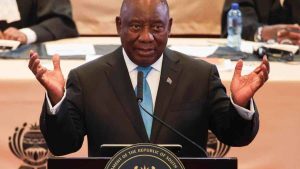
President Cyril Ramaphosa forced a national lockdown the following week, beginning almost two years of mandates and restrictions.
The DA argued that section 27 unconstitutionally deferred parliament’s authority to the minister, removing parliaments oversight role over the executive.
The High Court ruled against the DA, stating the DMA had “sufficient restraints” on executive power.
“[The High Court] found that there is a fundamental distinction between a state of emergency and a state of disaster, and that ordinary provisions for parliamentary oversight remain operative in a state of disaster,” the Constitutional Court explained on Friday.
The DA appealed the matter with the Supreme Court of Appeal (SCA), which was dismissed as the SCA agreed with the High Court’s view.
Oversight role of parliament
The matter reached the Constitutional Court earlier this month, with two judgements differing in their assessments.
The first judgement by Justice Zukisa Tshiqi stated that section 27 was unconstitutional, while a second judgement by Justice Leona Theron overruled Tshiqi’s assessment.
Tshiqi’s judgement stated that the DMA contained no specific mechanisms enabling the National Assembly to disapprove regulations issued by the Minister in a state of disaster.
“The judgement found that regulations issued under section 27 of the DMA may have similar effects on the fundamental rights to those permitted under a state of emergency,” the court stated.
The judgement claimed that Section 27 was unconstitutional not because of any overlaps between a state of disaster or state of emergency, but because it removed parliament’s oversight role in protecting fundamental rights.
“Although parliament held portfolio and select committee meetings and pursued formal parliamentary questions during the pandemic, these engagements do not indicate what consequences would follow if parliament disagreed with the minister,” the court explained.
(1/4) Judgment on Friday, 27 February 2026 at 09h00: A national state of disaster under section 27 of the Disaster Management Act does not amount to a de facto state of emergency.
— Constitutional Court (@ConCourtSA) February 27, 2026
Appeal dismissed
The second judgement argued that there were fundamental difference between a national state of disaster and a state of emergency
“Under a national state of disaster, the state will still be required to justify each and every limitation of a constitutional right in section 36(1),”
“A declaration of a national state of disaster neither suspends the constitutional order nor dilutes it. A state of emergency allows the executive to cut across all laws and the Bill of Rights,” the court explained.
However, the second judgement stated there was no constitutional requirement for the DMA to specifically provide for oversight as parliamentary oversight was an “obligatory component” of the constitution.
“The second judgement accordingly found that section 27 of the DMA was not unconstitutional for either creating a simulated state of emergency, or for not providing the National Assembly with a specific oversight power,” the court clarified.
“A national state of disaster under section 27 of the DMA does not amount to a de facto state of emergency,” it concluded.
Tshiqi’s judgement would have upheld the DA’s appeal, however, Theron’s judgement held and the appeal was dismissed.
NOW READ: Ramaphosa rests NHI rollout until legal challenges are settled
Support Local Journalism
Add The Citizen as a Preferred Source on Google and follow us on Google News to see more of our trusted reporting in Google News and Top Stories.