Surgically refreshed BMW 7 Series officially revealed

BMW South Africa has approved the facelift 7 Series from the final quarter of the year.
Introduced as the most controversially styled generation four years ago, BMW has given the internally named G70 7 Series its first mid-life restyling.
Foreshowing the 7 Series’ 50th anniversary next year, the updates borrow heavily from the Neue Klasse range comprising the iX3 and all-new i3.
New outside
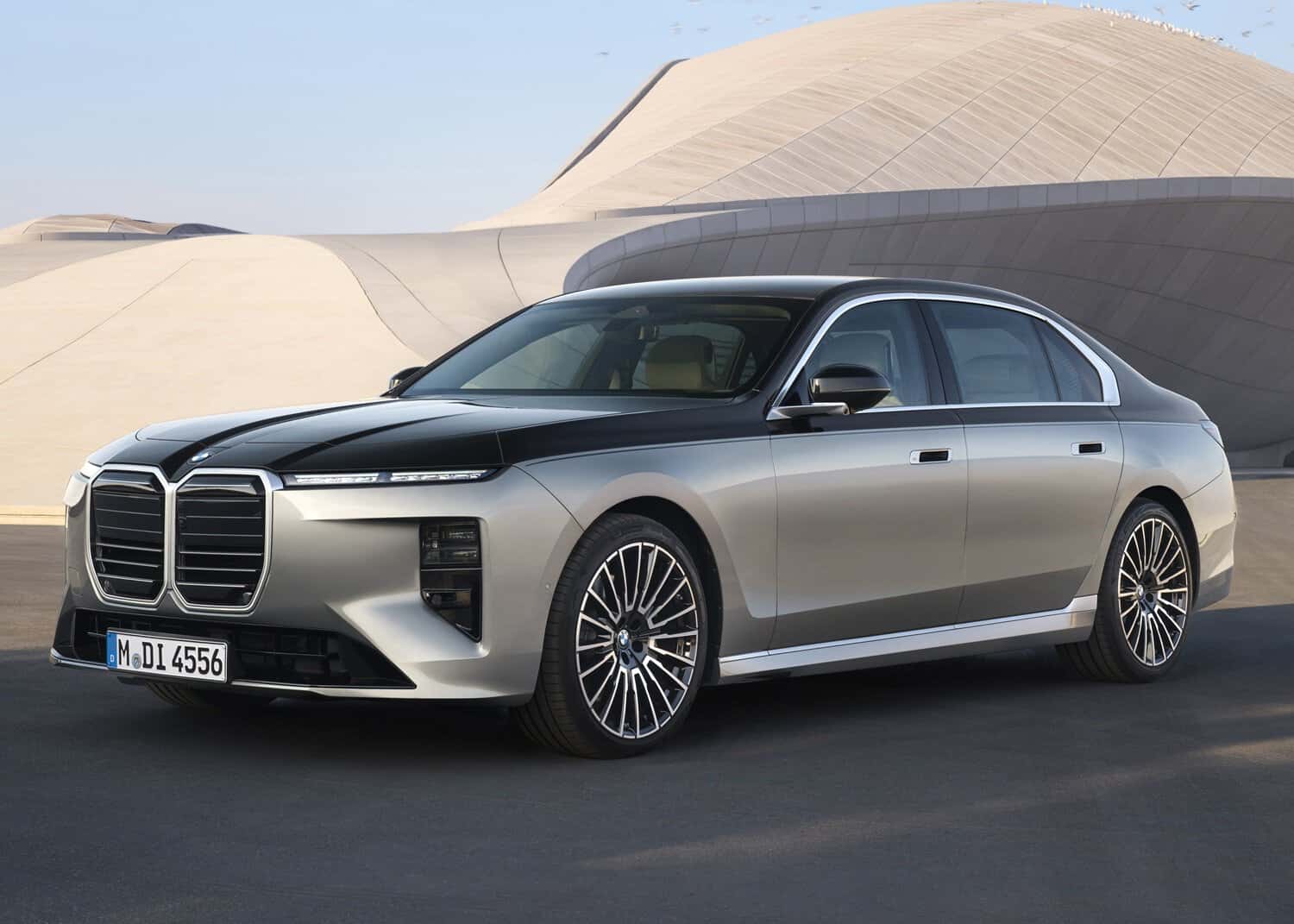
Billed as the most extensive update to any BMW model in recent years, the G70’s exterior tweaks are comparatively minor and require a keen eye to identify.
Unlike the Neue Klasse pair, the 7 Series, and its all-electric i7 sibling, are devoid of the slim kidney grille and thin headlights.
Instead, the upper headlight clusters, though ultra slim, are bespoke to the G70, with the same applying to the grille, which has been reduced in size and width.
Continuing is the Iconic Glow illuminated surround and the horizontal slates, which are, however, of a new design.
Rear facia design draws heavily from the iX3. Picture: BMW
The biggest frontal change is a new squared off bumper and lower air dam, plus wider side intakes on models equipped with the M Sport and M Sport Pro packages.
Slightly restyled is the bonnet and the BMW roundel, which has also been reduced in size and resides in the new central V-line of the former.
At the rear, the light clusters have been tweaked to resemble those of the iX3, while the bumper has been redesigned, as has the bootlid and lower faux diffuser.
As an option, the 7 Series can still be specified in a two-tone colour finish. The alloy wheels are new and range from 20 to 22 inches.
Almost new inside
Inside, the Neue Klasse touches are prominent, namely the same steering wheel and what BMW calls the Panoramic iDrive display.
As on the iX3, the latter comprises a pillar-to-pillar display at the base of the windscreen, replacing the conventional digital instrument cluster.
This meant a complete redesign of the dashboard, which also houses two new displays: a 17.1-inch infotainment system and a 14.6-inch display on the passenger side. Gone is the previous Interaction Bar that sat at the base of the dash.
Interior has undergone a prominent redesign Picture: BMW
Elsewhere, the centre console is also new and the drop-down 31.8-inch Theatre Screen at the rear is equipped with a touchscreen interface and an integrated camera.
Not stopping there, all models now come standard with the automatically opening and closing door, quad-zone climate control and upgraded seats, whether the standard chairs or the optional reclining Lounge seats at the rear.
As before, buyers have the option of two Bowers & Wilkins sound systems: the standard 18-speaker or the optional 1 925-watt 36-speaker Diamond unit with 3D Dolby Atmos surround sound.
Drop down 31.8-inch Theatre Screen now has a touchscreen interface. Picture: BMW
On the driver assistance front, BMW has scaled back to Level 2 autonomous driving capability, but fitted a new AI system called BMW Symbiotic Drive.
Working in tandem with this is a new Motorway Assistant which allows for hands-off driving, where permitted, at up to 130km/h.
Power choice
Petrol
Dynamically, the 7 Series has not been changed, although up front, more power has been extracted.
On the petrol side, the 740 loses the ‘i’ suffix, but introduces a new more powerful 3.0-litre straight-six turbocharged engine with outputs of 294kW/540Nm.
Not included is the 48-volt mild-hybrid system, which adds an additional 13kW/200Nm for short spells.
In Europe, the 740 will have the xDrive all-wheel drive system as standard. Top speed is limited to 250km/h, with 0-100km/h taking 5.1 seconds.
Diesel
Also continuing is the 740d, whose 3.0-litre straight-six oil-burner now makes 210kW/650Nm. As on the 740, the 740d has the xDrive system as standard.
Limited to 250km/h, the 740d will get from 0-100km/h in 5.7 seconds. It also retains the same mild-hybrid hardware as the 740, and the eight-speed Steptronic gearbox.
EV
On the electric side, the i7 has three variants, all using a brand-new 112.5kWh battery pack. As on the combustion models, all i7s are all-wheel drive as a result of utilising an electric motor on each axle.
On the 50 xDrive, combined output is 335kW/660Nm and 400kW/745Nm on the 60 xDrive.
Respective top speeds are 210km/h and 240km/h, with the former taking 5.5 seconds to hit 100km/h from standstill and the latter, 4.8 seconds.
The bigger battery means DC charging now up 250kW instead of 195kW, with the claimed waiting time from 10-80% dropping from 34 minutes to 28 minutes. Respective ranges are 591 and 581km.
At the i7 range’s summit, the M70 outputs 500kW/1 015Nm, with the latter increasing to 1 100Nm with the overboost mode activated.
This means a limited top speed of 250km/h, 0-100km/h in 3.8 and 3.5 second respectively, and a range of 566 km.
PHEV
On the plug-in hybrid side, the rear-wheel drive only 750e combines the 740’s petrol engine with an 18.7kWh battery pack.
Whereas the combustion engine develops 230kW/450Nm on its own, the electric outputs 145kW/280Nm for a combined 360kW/700Nm.
Paired to the eight-speed Steptronic ‘box, the 750e will get from 0-100km/h in 4.8 seconds and hit 250km/h. The all-electric range is 82km, and zero-emissions driving is capable up to 140km/h.
Finally, the M760 xDrive adds a second electric motor to the mix, resulting in it having all-wheel drive.
Combined, it develops 450kW/800Nm, allowing for a 250km/h top speed and 0-100km/h in 3.9 seconds. The all-electric range is 80km.
Coming to South Africa
Now available in Europe, BMW South Africa has confirmed the updated 7 Series from the final quarter of the year.
As a reminder, current 7 Series pricing ranges from R2 302 104 to R3 108 000. As such, expect the facelift model to potentially start at R2.5 million.